Peake STUDIES
ceased publication in 2015 (issue 14:iii).
This site is maintained with information about
the
contents of the journal,
what the press thought of Peake STUDIES,
the availability of back issues of PS
and of the old Mervyn Peake Review,
an essential primary and secondary bibliography,
Peake in Print,
a timeline of his life,
and a page of answers to
frequently asked questions about Peake.
Peake in Print
lists all known editions and impressions of books by Peake and illustrated by
Peake, plus his contributions to books and periodicals. Then it goes on to list
books (and parts of books) and articles about Peake, dissertations and theses
on Peake, and even a first-line and title index to Peake’s poetry.
You will also find pages about Mervyn Peake’s Vast
Alchemies (2009), Peter Winnington’s biography of Peake, and The
Voice of the Heart (2006), his study of the working of Peake’s imagination.
There’s a page of corrections and additions to Collected Poems, and to Complete Nonsense plus (below) links to other relevant sites.
What was in Peake STUDIES?
Articles from Peake STUDIES are now available on JStor.
back to top
Where to find it
From October 2013, Peake STUDIES was no longer a subscriber periodical; instead it
was published free
on the web: view the full issue as complete openings (= two-page spreads) on this site
– see the back issues page for details.
Previously, this site was paid for by subscriptions to Peake Studies. The journal having ceased publication, I must cover the expenses myself. Your support through a donation, however small, is greatly appreciated.
In volume 3, number 4, of the Journal of the Fantastic in the Arts, Brian Attebery wrote on PS volume 1, issues two and three:
‘This journal is both a sourcebook of materials and a guide to further reading. The production values and editorial standards are remarkably high for a publication that must necessarily have a limited audience’ (pp.151–2).
When Science Fiction Studies noticed Peake STUDIES, it called it ‘a very handsome journal.’ And the summer 1997 issue of Extrapolation (Vol.38, No.2) gave it favourable notice too.
On 12 April 2011, Wormwood’s blog called Peake STUDIES ‘one of the most consistently interesting and resourceful journals devoted to a single author in the fantasy field.’ This praise was repeated verbatim by the British Fantasy Society on June 5th.
Two years later, when the 50th issue came out, Wormwoodiana referred to
PS as ‘the most informative – and often under-recognised – periodical.’
A recent correspondent commented that ‘the editing style is refreshing, full of common sense and in no way ponderous (unlike so many journals).’
Back
copies of all issues to volume 13 issue iii are available, listed here.
As two issues appeared each year, and each volume (except the last) contained
four issues, the last (the 55th) was Vol. 14, No. 3, for October 2015. As usual, it
was published on schedule.
Details
of prices of back issues on paper and quantity discounts will be found at the head of the list of contents
of back issues.
Additionally, the contents of the old Mervyn Peake Peake Review (1975–1982) are listed on this site, along with details of how to buy scans of them.
Contributing to Peake STUDIES
Articles are no longer solicited, but
students completing a dissertation on Peake are encouraged to send in details of
it for inclusion in the bibliography on
this site.
Similarly, if you come across an article on Peake or a discussion of his
work in a book (more than just a passing mention), please send details so that
the information can be added to parts G or H of Peake in
Print.
Please submit your contribution by e-mail
for consideration.
back to top
The Editor
Peake STUDIES was edited by G. Peter Winnington
who can be contacted by e-mail. He is the
author of Vast Alchemies: the life and work of Mervyn
Peake which was published in 2000; it was replaced by
Mervyn Peake’s Vast Alchemies in 2009, with updated information and more than 60 new illustrations.
It is now available as an ebook, with fresh information and some new
illustrations.
His The Voice of the Heart: the working of Mervyn
Peake’s imagination,
the first critical study to discuss all of Peake’s work
– novels, short stories, poems, illustrations, and plays –
was published in 2006 in hardback and
paperback by Liverpool University Press (in the UK) and distributed in the USA by Chicago
University Press.
He also edited Mervyn Peake: the man
and his art, a much sought-after book
which was published by Peter
Owen in 2006, and the volume of papers from the 2011 Chichester Centenary Conference, Miracle Enough: papers on the papers of Mervyn Peake.
A collection of Peter’s articles about Peake is available.
Links
There is a
site originated by Peake’s son Sebastian, which contained news of forthcoming publications
and exhibitions. It does not seem to be updated now.
If you are wanting to buy secondhand copies of items by Peake,
you should visit the sites of
Mr
Pye Books and Cameron
House.
For paintings and drawings by Peake, contact Chris
Beetles who has a London gallery.
Works by Peake regularly come up for
sale at major auction houses such as Christies
and Bonham’s.
If you simply
want brief (and reliable) information about Mervyn Peake’s life and work,
go to The
Literary Encyclopedia and Literary Dictionary. Beware – some sites indulge
in fantastical nonsense, like listing The Craft of the Lead Pencil and
The Glassblowers as novels! A rational and balanced assessment of the Titus
books can be found on the Great
Science-Fiction and Fantasy site.
For
articles on illustrators and the art of illustration, see Illustration
magazine.
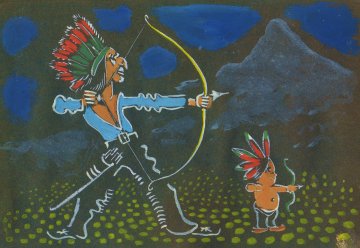
All images by Mervyn Peake on this website are © the Mervyn Peake Estate.